Polynomials are one of the most important topics in CBSE Class 10 Maths. Among them, finding the zeros of a polynomial is a frequently asked concept in exams.
In this guide, we’ll break it down in a simple and easy way so you can understand and solve questions confidently.
🔍 What is a Polynomial?
A polynomial is an algebraic expression made up of variables and constants.
Examples:
- ( x + 2 )
- ( x^2 – 3x + 2 )
- ( 2x^3 + 5x – 1 )
🎯 What are Zeros of a Polynomial?
A zero of a polynomial is the value of ( x ) for which the polynomial becomes zero.
👉 In simple words:
Put a value of ( x ) in the polynomial → if the result is 0 → that value is a zero.
🧠 Method 1: Finding Zeros by Factorization
Example:
Find the zeros of:
( x^2 – 5x + 6 )
Step 1: Factorize
( x^2 – 5x + 6 = (x – 2)(x – 3) )
Step 2: Set each factor to zero
- ( x – 2 = 0 ) → ( x = 2 )
- ( x – 3 = 0 ) → ( x = 3 )
✅ Zeros are: 2 and 3
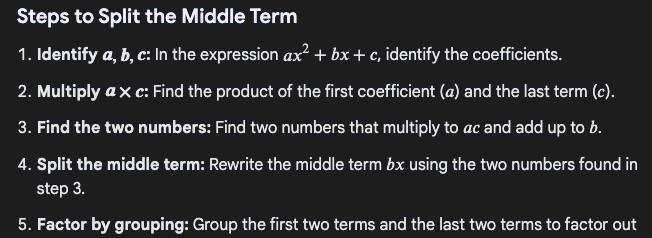
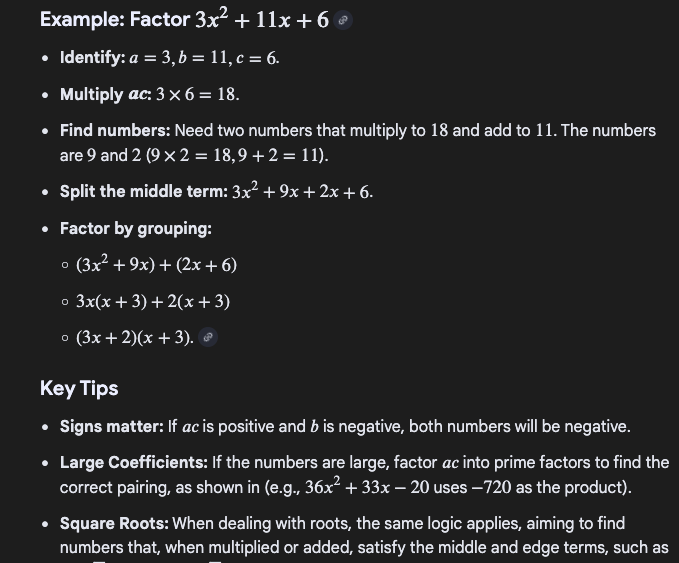
Middle Term Splitting – To find factors



📊 Method 2: Using Graphs
If you draw the graph of a polynomial:
- The points where the graph cuts the x-axis are the zeros.
👉 Example:
For a quadratic graph (parabola), it may:
- Cut x-axis at 2 points → 2 zeros
- Touch x-axis at 1 point → 1 zero
- Not touch → no real zero
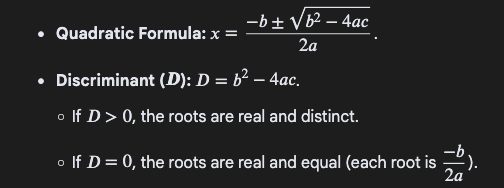
🧮 Method 3: Quadratic Formula (For Class 10)
For a polynomial:
( ax^2 + bx + c )
Use formula:

Example:
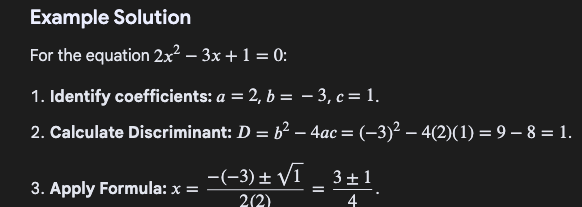
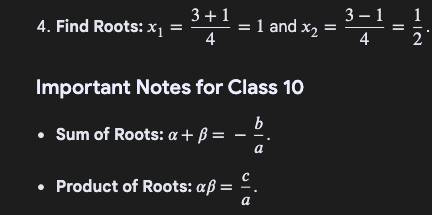
Another Example with Quadratic Formula
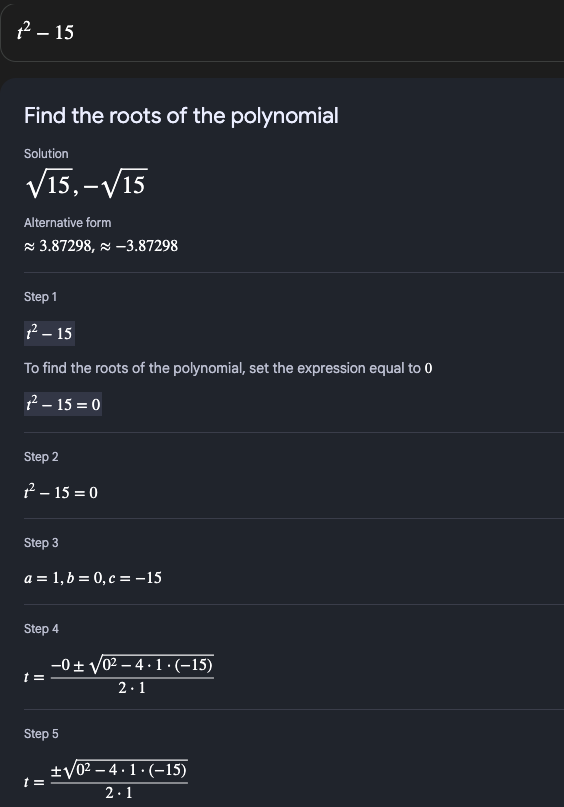
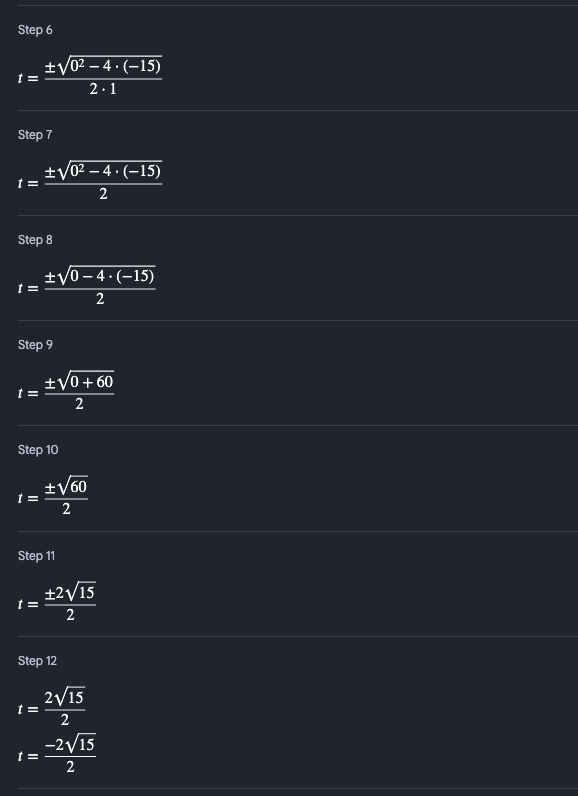
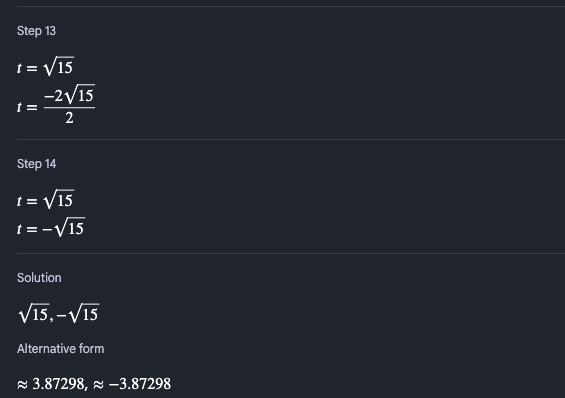
💡 Important Tips for Exams
✔ Always try factorization first (fastest method)
✔ Check your answers by substituting values
✔ For graphs, focus on where it touches the x-axis
✔ Practice different types of polynomials
❓ Practice Questions
- Find zeros of ( x^2 – 7x + 10 )
- Find zeros of ( 2x^2 – 4x = 0 )
- Check if ( x = 1 ) is a zero of ( x^3 – 1 )
📝 Conclusion
Understanding zeros of polynomials is very important for CBSE exams. Once you practice factorization and formulas, this topic becomes very easy.
👉 Keep practicing, and you’ll master it in no time!
Want more Class 10 Maths notes? Stay tuned for more simple guides!