✨ What is Light?
Light is a form of energy that enables us to see objects. It travels in a straight line and can undergo reflection and refraction.
🔁 Reflection of Light
Reflection is the bouncing back of light when it strikes a surface.
📐 Laws of Reflection (Detailed Explanation)
The behavior of reflected light is governed by two important laws:
✅ 1. Angle of Incidence = Angle of Reflection
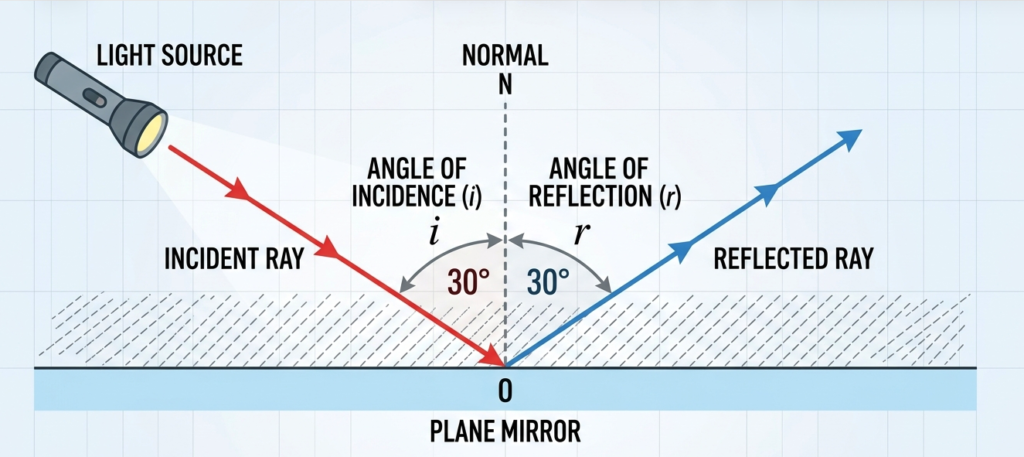
- The angle at which light hits the surface is called the angle of incidence (∠i)
- The angle at which it reflects back is called the angle of reflection (∠r)
- These two angles are always equal
👉 Mathematically:
<i = <r
👉 Example:
If a ray of light strikes a mirror at 30°, it will reflect at 30°.
✅ 2. Incident Ray, Reflected Ray, and Normal Lie in the Same Plane
- The incident ray (incoming light),
- The reflected ray (outgoing light), and
- The normal (imaginary perpendicular line to the surface)
👉 All lie in the same flat surface (plane).
📌 What is a Normal?
A normal is an imaginary line drawn perpendicular (90°) to the reflecting surface at the point of incidence.
🌍 Real-Life Examples of Laws of Reflection
- Seeing your image in a mirror
- Reflection of light in calm water
- Periscopes used in submarines
- Kaleidoscopes creating patterns
🔍 Types of Reflection
- Regular Reflection – smooth surfaces (mirror)
- Diffuse Reflection – rough surfaces (walls)
🌈 Refraction of Light
Refraction is the bending of light when it passes from one medium to another.
📌 Example:
A pencil in water appears bent due to refraction.
❓ MCQs
- The angle of incidence is always equal to:
a) Angle of deviation
b) Angle of reflection
c) Angle of refraction
d) None - The normal is drawn at:
a) 45°
b) 60°
c) 90°
d) 180° - Incident ray and reflected ray lie in:
a) Different planes
b) Same plane
c) Parallel planes
d) Curved plane - Refraction occurs due to change in:
a) Speed of light
b) Direction only
c) Color
d) Size
Provide your answers in comments