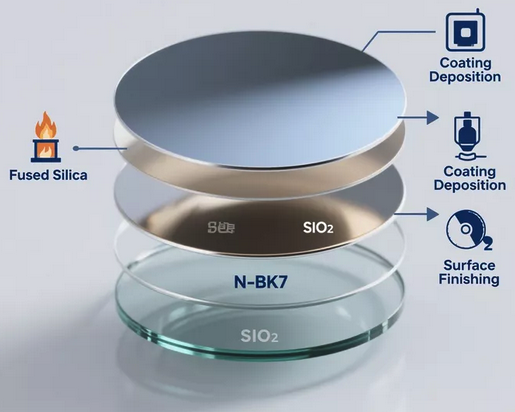
A spherical mirror is a mirror whose reflecting surface is a part of a hollow sphere. These mirrors are widely used in daily life due to their ability to form different types of images.
📌 Types of Spherical Mirrors:
- Concave Mirror (Converging Mirror)
- Reflecting surface is curved inward (like the inside of a bowl)
- Converges parallel rays of light to a point
- Convex Mirror (Diverging Mirror)
- Reflecting surface bulges outward
- Diverges light rays (spreads them out)
📐 Important Terms Related to Spherical Mirrors
Understanding these terms is essential for ray diagrams and numericals:
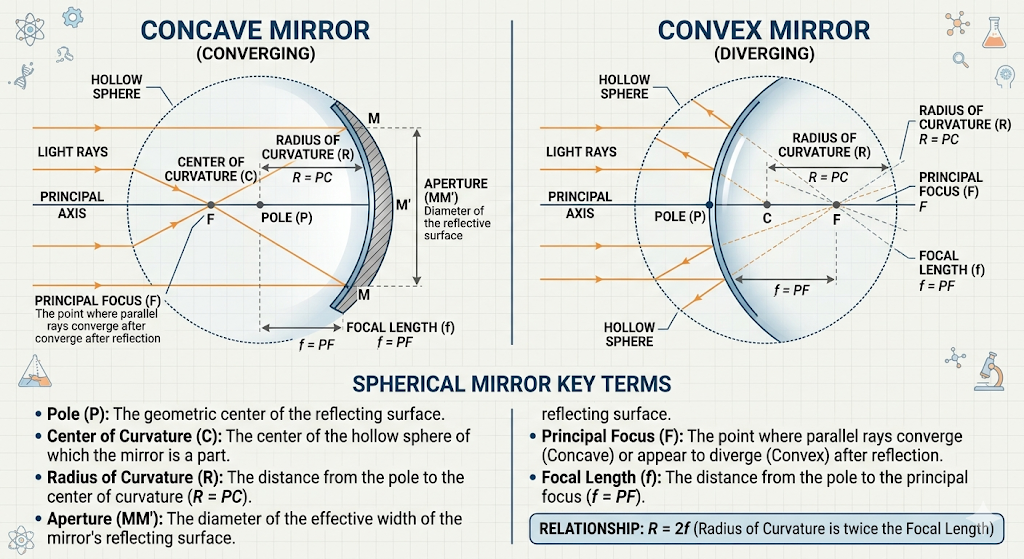
🔵 1. Pole (P)
- The pole is the center point of the mirror’s reflecting surface.
- It lies on the surface of the mirror.
👉 It acts as the reference point for measuring distances.
🔵 2. Centre of Curvature (C)
- The centre of curvature is the center of the sphere of which the mirror is a part.
- It lies outside the mirror.
👉 For a concave mirror → in front of the mirror
👉 For a convex mirror → behind the mirror
🔵 3. Radius of Curvature (R)
- The distance between the pole (P) and the centre of curvature (C).
👉 Formula:
R = PC
👉 It is always twice the focal length:
R = 2f
🔵 4. Principal Axis
- An imaginary straight line passing through the pole (P) and centre of curvature (C).
👉 All important points lie on this axis.
🔵 5. Principal Focus (F)
- The point where parallel rays of light meet (concave) or appear to diverge (convex) after reflection.
👉 For concave mirror → real focus (in front)
👉 For convex mirror → virtual focus (behind)
🔵 6. Focal Length (f)
- The distance between the pole (P) and the focus (F).
👉 Formula:
f = R/2
🔵 7. Aperture
- The diameter of the reflecting surface of the mirror.
👉 A larger aperture → wider area to collect light
📊 Summary Table
| Term | Definition | Concave Mirror | Convex Mirror |
|---|---|---|---|
| Pole (P) | Center of mirror | On surface | On surface |
| Centre of Curvature (C) | Center of sphere | In front | Behind |
| Focus (F) | Point of reflection | Real | Virtual |
| Focal Length (f) | Distance PF | Positive/Negative (depends on sign convention) | Positive/Negative |
| Radius (R) | Distance PC | R = 2f | R = 2f |
| Aperture | Mirror size | Same | Same |
🔎 Image Formation by Concave Mirror
- Object beyond C → real, inverted, diminished
- Object at C → real, inverted, same size
- Object between C and F → real, inverted, enlarged
- Object between F and P → virtual, erect, enlarged
🚗 Convex Mirror Characteristics
- Always forms virtual, erect, diminished images
- Provides a wide field of view
👉 That’s why it is used as a rear-view mirror in vehicles.
🌍 Real-Life Examples
- Concave Mirrors:
- Shaving mirrors (enlarged image)
- Solar cookers (focus sunlight)
- Convex Mirrors:
- Rear-view mirrors
- Security mirrors in shops
❓ MCQs
- The radius of curvature is equal to:
a) f
b) 2f
c) f/2
d) 4f - The centre of curvature of a convex mirror lies:
a) In front
b) Behind
c) At pole
d) At infinity - Aperture of a mirror is:
a) Radius
b) Diameter of reflecting surface
c) Focus
d) Axis - Concave mirror converges light to:
a) Pole
b) Focus
c) Centre
d) Axis
Provide your answers in comments
Click to view the answers
**Answers:** 1-b, 2-b, 3-b, 4-b